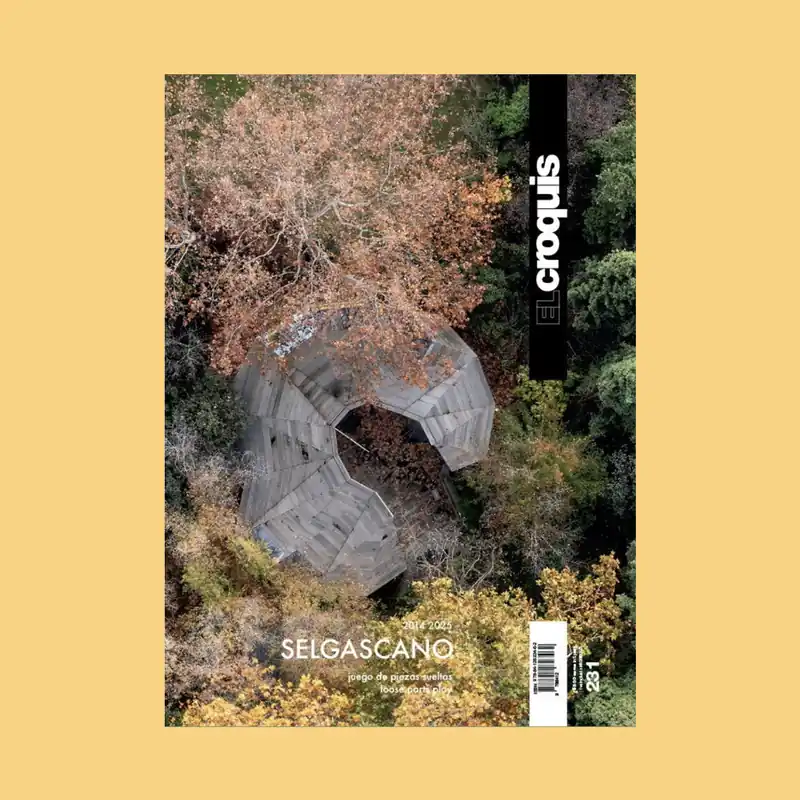

The Spanish architecture firm SelgasCano was founded in 1998 by architects José Selgas and Lucía Cano, who have since built a reputation for their creative use of materials and focus on the relationship between architecture and nature. Following on an earlier issue of ‘El Croquis’ featuring work by the Madrid-based practice completed between 2003 and 2013, this one presents the studio’s work since then, including the Bathing Pavilion at the Bruges Triennial, Beijing Xicheng Exhibition Hall, a bookshop on Hanbury Street in London, and several homes. The studio is recognised for its lightweight, transparent designs and experimental use of colour and new technologies.
Selgascano’s practice began in Madrid in 1992, established a dedicated workspace in 1996, and relocated in 2006 to their current studio, named the Office in the Woods – notably, the most visited project on Archdaily to date– Conceived as a small-scale workshop, the studio has always intended to preserve its intimate scale. José Selgas and Lucía Cano tend to refrain from giving public lectures, choosing instead to devote themselves entirely to their projects.
Each commission is approached as a distinct complexity, with its own internal logic and personality. History, memory, economy, perception, and nature form the core elements that inevitably shape the architectural response. This outcome is refined through the architects’ complete involvement in the construction process, understood as a continuous, attentive dialogue with all elements at play –from fabrication to installation– coupled with an ongoing investigation into how conventional solutions might be reinterpreted and streamlined for architectural use.
The studio has always avoided the use of devices and mechanisms stemming from personal disciplinary concerns, instead pursuing a form of beauty that can be understood by any human being. In every project, and increasingly so, it is essential for the studio that architecture relinquish as much space as possible to nature, and that the presence of the built environment be minimised or reduced to those elements which, through artificial means and the application of technologies borrowed from fields rarely associated with architecture, enable the emergence of future forms of nature.