
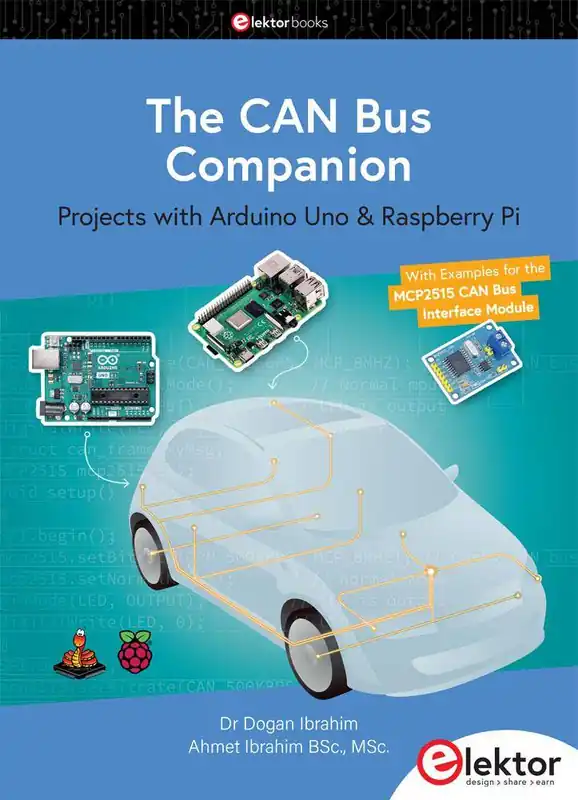

This book details the use of the Arduino Uno and the RaspberryPi4 in practical CANbus based projects. Using either the ArduinoUno or the RaspberryPi with off-the-shelf CANbus interface modules considerably ease developing, debugging, and testing CANbus based projects.
This book is written for students, practicing engineers, enthusiasts, and for everyone else wanting to learn more about the CANbus and its applications. The book assumes that the reader has some knowledge of basic electronics. Knowledge of the C and Python programming languages and programming the ArduinoUno using its IDE and RaspberryPi will be useful, especially if the reader intends to develop microcontroller-based projects using the CANbus.
The book should be a useful source of reference material for anyone interested in finding answers to questions such as:
– What bus systems are available for the automotive industry?
– What are the principles of the CANbus?
– How can I create a physical CANbus?
– What types of frames (or data packets) are available in a CANbus system?
– How can errors be detected in a CAN bus system and how dependable is a CANbus system?
– What types of CAN bus controllers exist?
– How do I use the MCP2515 CANbus controller?
– How do I create 2-node ArduinoUno-based CANbus projects?
– How do I create 3-node ArduinoUno-based CANbus projects?
– How do I set the acceptance masks and acceptance filters?
– How do I analyze data on the CANbus?
– How do I create 2-node RaspberryPi-based CANbus projects?
– How do I create 3-node RaspberryPi-based CANbus projects?
The full program listings of all the projects discussed in the book may be downloaded free of charge from the Elektor website www.elektor.com/20405.